
Most central heating problems announce themselves the same way. A room that never warms up. A boiler that clicks and gives up. A radiator hot along the top and cold underneath. The symptom is rarely the fault. Before you blame a part, sort the house into one of two families of failure. They share almost no tests, no parts and no legal boundary about who may touch them, so a guess at this stage wastes a weekend.
The question that splits central heating problems in two
It costs nothing to answer, and it decides everything after it. Nearly all central heating problems sit on one side of it or the other.
In the first family the boiler never gets as far as making heat. It will not ignite. Or it ignites and locks out. Or it holds pressure for a fortnight, then sinks again. Everything downstream is innocent. The fault sits in the appliance, in the sealed water circuit that feeds it, or in the condensate drain that carries its waste water away.
In the second family the boiler works. The flow pipe leaving it gets genuinely hot. The pump runs. Yet the heat does not arrive where it is wanted. Air, sludge, a seized valve, a circuit nobody balanced, a control that lies about the temperature — none of that is cured by touching the boiler. All of it gets blamed on the boiler anyway.
One hand on the flow pipe tells you which family you are in. Mind the heat. On a system running normally that pipe is uncomfortable to hold.
The ten-minute check before you touch anything
Do all of this before you buy a part or book a visit. Most central heating problems are identified here, with nothing in your hands.
- Read the gauge twice. Once with the heating off for several hours, so the water is cold, and again at full working temperature. Write both numbers down with the date. A single reading is almost useless; the pair is the diagnosis.
- Listen to one ignition attempt. Turn the heating on from cold and stand next to the boiler. A fan, a series of clicks, then a settled burn is a boiler that works. Clicks that repeat and stop is a lockout.
- Feel the two pipes leaving the boiler. Flow hot and return warm means water is circulating. Both lukewarm while the burner roars means it is not.
- Feel each radiator in three places: top, bottom, and the far end from the valve. Note the pattern for each one.
- Find the condensate pipe outside. On a condensing boiler it is a plastic pipe, usually white or grey, leaving the wall near the appliance and ending at a drain or gully. In a hard frost it matters more than anything else on this list.
- Look for water. Under the boiler, along the skirting board near radiator valves, and at the end of the copper pressure relief pipe that discharges outside.
If the cold reading is low and keeps falling, you are in branch one. If the cold reading is steady while the radiators disagree with each other, you are in branch two.
Branch one: it will not fire, or the pressure keeps falling
Worcester Bosch tells UK householders that a sealed system should run between 1 and 1.5 bar. The needle should sit in that band. When it falls below the 1 bar mark, the system needs refilling. The same guide says a boiler that repeatedly exceeds its operating pressure, discharges or shuts down belongs to a heating engineer.
Frequency matters more than the number, and frequency is the part householders ignore. Worcester Bosch's UK and Irish support pages both put normal top-up frequency at once or twice a year. Both say anything much more frequent is a call to your installer, not a job you keep repeating. British Gas gives the same band: the gauge "should read between 1 and 1.5".
French and German documentation draws the lower limit harder. De Dietrich's INNOVENS MCA manual puts a low-water fault on the display — DEF MANQUE EAU, code L250 — once pressure falls below 0.8 bar. Vaillant's flexoTHERM exclusive manual specifies a minimum heating-circuit pressure of 0.50 bar, plus a minimum operating pressure of 0.70 bar. When pressure sits below those figures, the appliance is not being fussy. It genuinely cannot circulate.
Two things here are worth checking before anyone is paid to attend. If the drop began in freezing weather, and the boiler locks out each morning but restarts after a thaw, suspect the condensate pipe freezing outside. If you are refilling monthly, the real question is where the water goes. That is a different investigation from topping up. It is also the one that ends the problem, and it is the subject of a boiler that will not hold its pressure.
The copper discharge pipe outside is the third clue. Vaillant requires a heating safety valve with an opening pressure of 3 bar. De Dietrich fits a 3 bar valve on the heating side of the MCA range, plus a separate 7 bar valve on the hot water side of the MCA 25/28 BIC. Three documents from two countries give the same 3 bar figure, so it is a reasonable expectation rather than a guess. When water drips from that pipe, the system has reached it. Usually that is a failed expansion vessel, not a failed boiler.
Branch two: the boiler runs but the heat does not arrive
The gauge is steady and the flow pipe is hot. So stop looking at the appliance: these central heating problems live in the distribution, not the boiler. Cold outer walls behind cold radiators are a separate matter, and telling damp from condensation comes first there.
A radiator warm across the top and cold along the bottom is the classic water-side pattern. It has three usual explanations, and they need separating before anything is bought — see a radiator that stays cold at the bottom. A radiator cold all over while its neighbours are hot is a different problem. The suspects then are a seized valve pin, a closed lockshield, or a circuit nobody balanced. Where one room alone stays cold and the rest of the house is comfortable, the controls and the valve settings come first, not the pipework. That case is handled in why one room is always cold.
One sanity check while you are there. The AYOR 29-12 S expansion vessel sold for domestic heating in France is rated for water from -10 °C to +90 °C. Heating water is hot, not boiling, so a radiator you cannot keep a hand on is behaving normally.
Why the manuals disagree about the right pressure
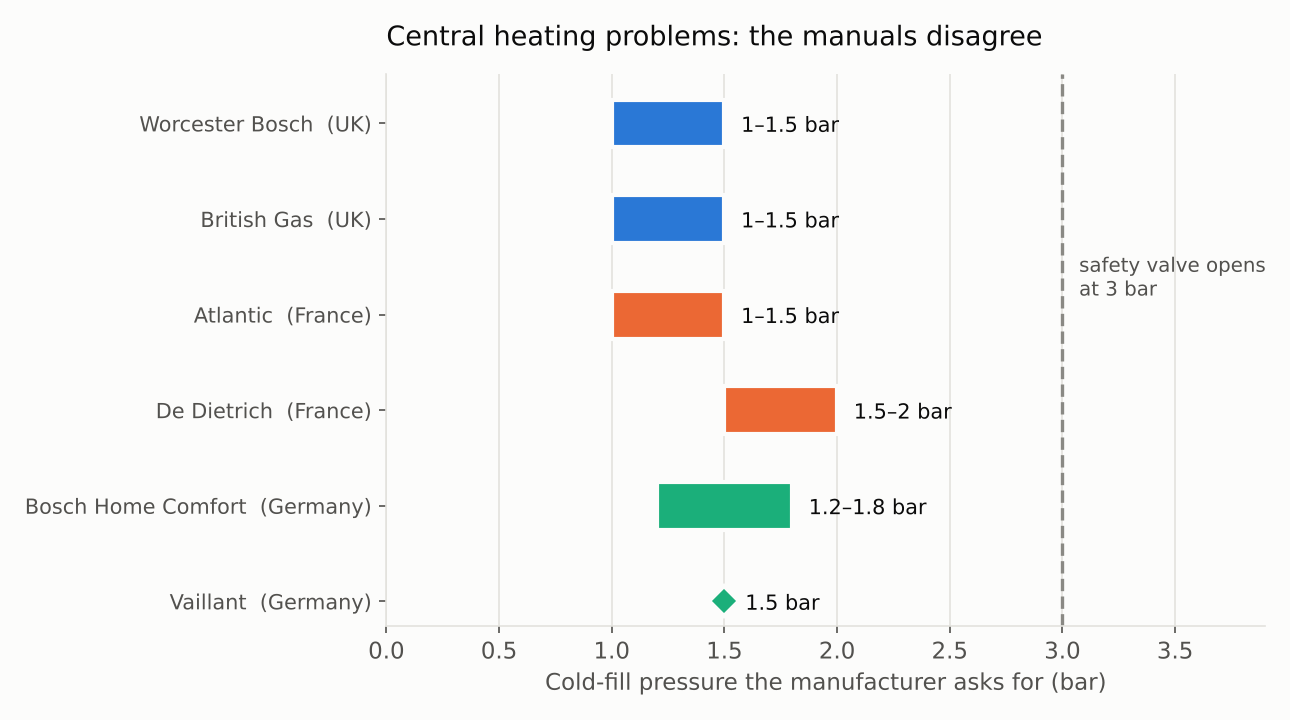
Convergence first, because it is what makes the rest trustworthy. Three consumer-facing sources in two countries give 1 to 1.5 bar. Worcester Bosch and British Gas say so in the UK. Atlantic says so in France, where 1 to 1.5 bar is the green zone on its Naia and Naema gauges, and where owners are told to shut the filling valve once the needle arrives there.
The divergence is real, and averaging it away would lose the point.
| Source | Country | Figure given |
|---|---|---|
| Worcester Bosch, System filling guide | UK | 1 – 1.5 bar operating |
| British Gas, repressurising guide | UK | 1 – 1.5 bar |
| Atlantic, Naia / Naema support page | France | 1 – 1.5 bar, green zone |
| De Dietrich, INNOVENS MCA manual | France | 1.5 – 2 bar; stop filling at 2 bar |
| Bosch Home Comfort | Germany | 1.2 – 1.8 bar for a two-storey house |
| Vaillant, flexoTHERM exclusive manual | Germany | fill to approx. 1.5 bar |
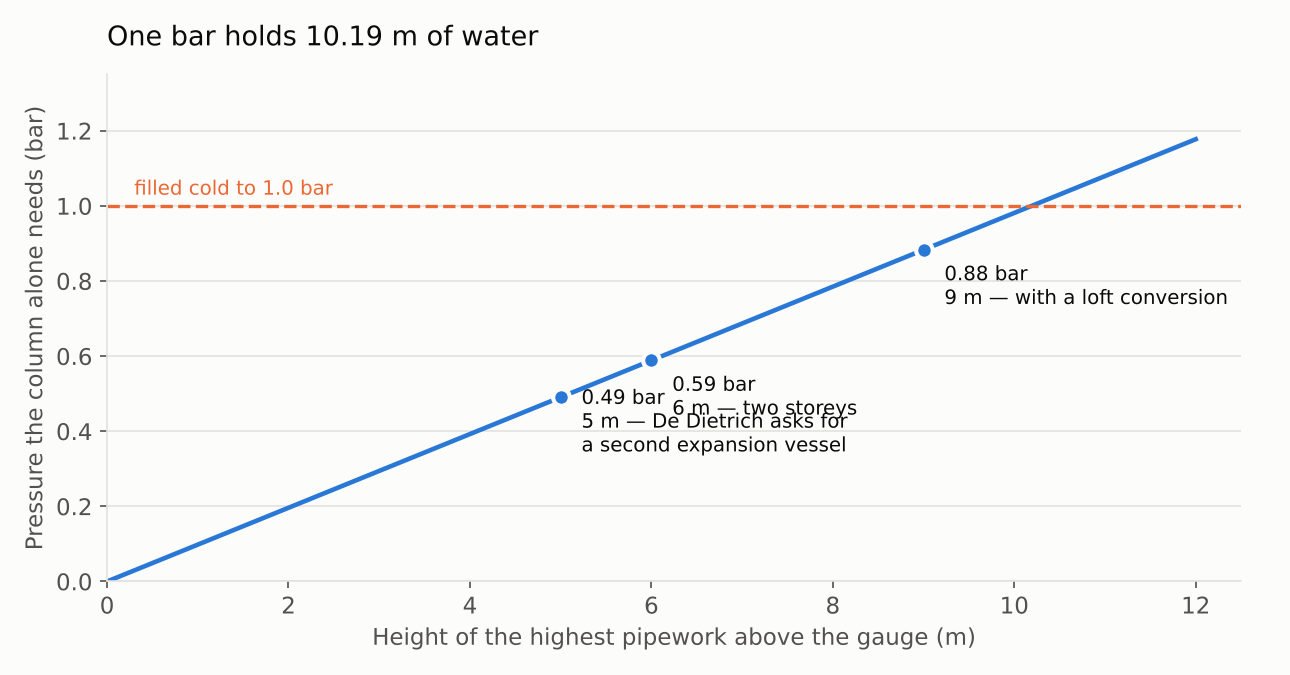
Height explains much of it, and the arithmetic is checkable. Pressure at the bottom of a water column is density times gravity times height. Take water at 1000 kg/m³ and gravity at 9.81 m/s². One bar is 100000 Pa, so one bar supports 100000 / (1000 × 9.81) = 10.19 m of water.
Now take a two-storey house, boiler in a ground-floor kitchen, highest pipework about 6 m above the gauge. Holding that column takes 1000 × 9.81 × 6 = 58860 Pa, which is 0.589 bar. Fill cold to 1.0 bar and only 0.41 bar is left at the top. Add a loft conversion, call it 9 m, and the column alone wants 0.883 bar. Roughly 0.12 bar then remains at the highest radiator, which is why air keeps appearing there. Bosch Home Comfort says plainly that a taller building needs more pressure. De Dietrich requires a second expansion vessel once static height exceeds 5 m, a height worth 0.49 bar on its own.
So a German figure of 1.2 to 1.8 bar and a British figure of 1 to 1.5 bar can both be right. Taller housing stock, same physics.
What central heating problems usually cost to put right
No prices appear here on purpose. Order-of-magnitude figures for parts and labour move quickly and vary by region, so quote them locally: ask a merchant or an installer for a current figure rather than budgeting from something read online.
What you can control is the order of spending. Cheap and reversible first: gauge readings, a condensate check, valve positions, balancing. Then the expansion vessel, which is a re-charge before it is a replacement. A new appliance is the last item on that list. An installer who reaches it without showing you a test result has skipped the work.
What does not work
- Topping up every few weeks. Worcester Bosch's own figure is once or twice a year. Beyond that, refilling treats the gauge rather than the leak, and every refill brings fresh oxygenated water into the circuit.
- Bleeding every radiator as a reflex. Bleeding releases water as well as air, so it lowers system pressure. That is exactly why Worcester Bosch recommends it for bringing an over-pressurised system back down from 1.5 bar or above. On a system already short of water it makes branch one worse.
- Filling higher than the vessel pre-charge. The De Dietrich manual states the rule directly: system filling pressure must be less than or equal to the expansion vessel's inflation pressure. The AYOR vessel above leaves the factory pre-charged to 1.5 bar with nitrogen, rated to a maximum of 3 bar. Pumping past the pre-charge does not buy headroom. It removes it.
- Turning the flow temperature to maximum because one room is cold. In branch two the boiler was already making enough heat. More heat does not redirect it, and it costs more gas.
- A new thermostatic head for a radiator that is cold all over. If the pin under the head is seized, a new head closes onto the same stuck pin.
- Chemical inhibitor as a cure. Inhibitor is sold to protect a clean system against future corrosion. It is not a solvent for a radiator already packed with debris.
Where your competence ends
In the UK, work on gas pipework, the gas valve, the burner, the sealed combustion chamber and the flue is for a Gas Safe registered engineer. That is a legal boundary, not a cautious suggestion. It is also the line past which a DIY attempt voids most warranties.
Everything in the ten-minute check sits on your side of it, because none of it opens the appliance. So does reading a gauge, feeling pipes, finding the condensate outlet, and noting which radiators do what. Draining a system to re-charge an expansion vessel does not. That means isolating, dumping and refilling a sealed circuit, and De Dietrich treats the vessel pre-charge as a commissioning and annual-service item for exactly that reason.
Arrive at the engineer with two gauge readings, a date, a frequency, and a list of which radiators misbehave. That conversation is shorter, cheaper, and much harder to upsell.
Surse
- Worcester Bosch (UK), System filling guide (PDF) — https://installer.worcester-bosch.co.uk/files/news/System_filling_guide.pdf Supports: sealed-system operating pressure of 1 to 1.5 bar; refill below 1 bar; bleed a radiator to bring pressure back down from 1.5 bar or above; repeated over-pressure, discharge or shutdown is an engineer's job.
- Worcester Bosch (UK), boiler pressure advice — https://worcester-bosch.co.uk/heating-advice/boiler-pressure Supports: fill target of "just about one bar" / "just over one bar" across external, keyed and keyless filling loops.
- Worcester Bosch (UK), support FAQ on top-up frequency — https://www.worcester-bosch.co.uk/professional/support/troubleshooting/faqs/home-heating-faqs/how-often-should-i-need-to-top-up-the-pressure-in-the-heating-system Supports: "once or twice a year" as normal; much more frequent repressurising means contacting the installer.
- Worcester Bosch (Ireland), same FAQ — https://www.worcester-bosch.ie/support/troubleshooting/faqs/all-faqs/how-often-should-i-need-to-top-up-the-pressure-in-the-heating-system Supports: the identical frequency guidance published for a second country.
- British Gas (UK), how to repressurise your boiler — https://www.britishgas.co.uk/heating/guides/how-to-repressurise-your-boiler.html Supports: "the gauge should read between 1 and 1.5"; leaks and radiator bleeding named as the two main causes of pressure loss.
- Bosch Home Comfort (Germany), Heizung Wasser nachfüllen — https://www.bosch-homecomfort.com/de/de/wohngebaeude/wissen/heizungsratgeber/heizung-wasser-nachfuellen/ Supports: 1.2 to 1.8 bar in the heating circuit of a normal two-storey single-family house; "Ist das Gebäude höher, ist auch mehr Druck nötig"; the target value comes from the installer and the system documentation.
- Vaillant flexoTHERM exclusive installation manual (Germany; PDF hosted by the German merchant heizungsdiscount24) — https://www.heizungsdiscount24.de/pdf/Vaillant-flexoTHERM-exclusive-Installationsanleitung.pdf Supports: fill to "Heizungsanlagendruck von ca. 1,5 bar"; minimum heating-circuit pressure ≥ 0.50 bar; minimum operating pressure ≥ 0.70 bar; heating safety valve at least DN 20 with a 3 bar opening pressure.
- De Dietrich INNOVENS MCA installation manual (France) — https://sav.dedietrich-thermique.fr/gpdf/generate/194261/ Supports: installation water pressure between 1.5 and 2 bar and stop filling at 2 bar; "DEF MANQUE EAU" fault code L250 below 0.8 bar; 3 bar heating safety valve and 7 bar domestic hot water valve on the MCA 25/28 BIC; a second expansion vessel where static height exceeds 5 m; system filling pressure must be less than or equal to the vessel's inflation pressure; vessel pre-charge checked at commissioning and at each annual service.
- Atlantic (France), raising the pressure on a Naia / Naema boiler — https://www.atlantic.fr/aide/chaudiere/fonctionnement-utilisation/comment-remonter-la-pression-sur-ma-chaudiere-naia-naema-version-1-2 Supports: 1 to 1.5 bar as the ideal green-zone pressure; close the filling valve on reaching it; above 2 bar bleed the radiator nearest the boiler; repeated adjustment points to a leak or an expansion vessel fault.
- AYOR / Somatherm 29-12 S expansion vessel data sheet (France) — https://www.robinetterie-hammel.fr/var/docs/produits/fiches/Somatherm_29-12_S.pdf Supports: 12 litre diaphragm vessel, "Pré-gonflage 1,5 bar (Azote)", "Pression maxi. 3 bar", operating range -10 °C to +90 °C.
Countries represented: United Kingdom, Ireland, Germany, France. Every source above was opened and read before being cited.
Reproducible calculation, checked by running it. Static pressure of a water column: p = ρ g h, with ρ = 1000 kg/m³ and g = 9.81 m/s². One bar = 100000 Pa, so 1 bar supports 100000 / (1000 × 9.81) = 10.19 m of water. At h = 3 m, p = 29430 Pa = 0.294 bar. At h = 6 m, p = 58860 Pa = 0.589 bar. At h = 9 m, p = 88290 Pa = 0.883 bar. At the De Dietrich 5 m threshold, p = 49050 Pa = 0.490 bar. Residual pressure at the top of the circuit when filled cold to 1.0 bar: 0.411 bar at 6 m, 0.117 bar at 9 m.