
A drain backs up. A contractor quotes for digging the garden. Nobody in the conversation can say whose pipe it is. That question is not pedantry: who is responsible for drains decides whether you pay for the excavation or whether your water company owns the problem. The answer rarely depends on where the mess appeared. It depends on a line on the ground and a date in 2011.
Most households get this wrong in the expensive direction. They pay to clear a length of pipe that stopped being theirs more than a decade ago.
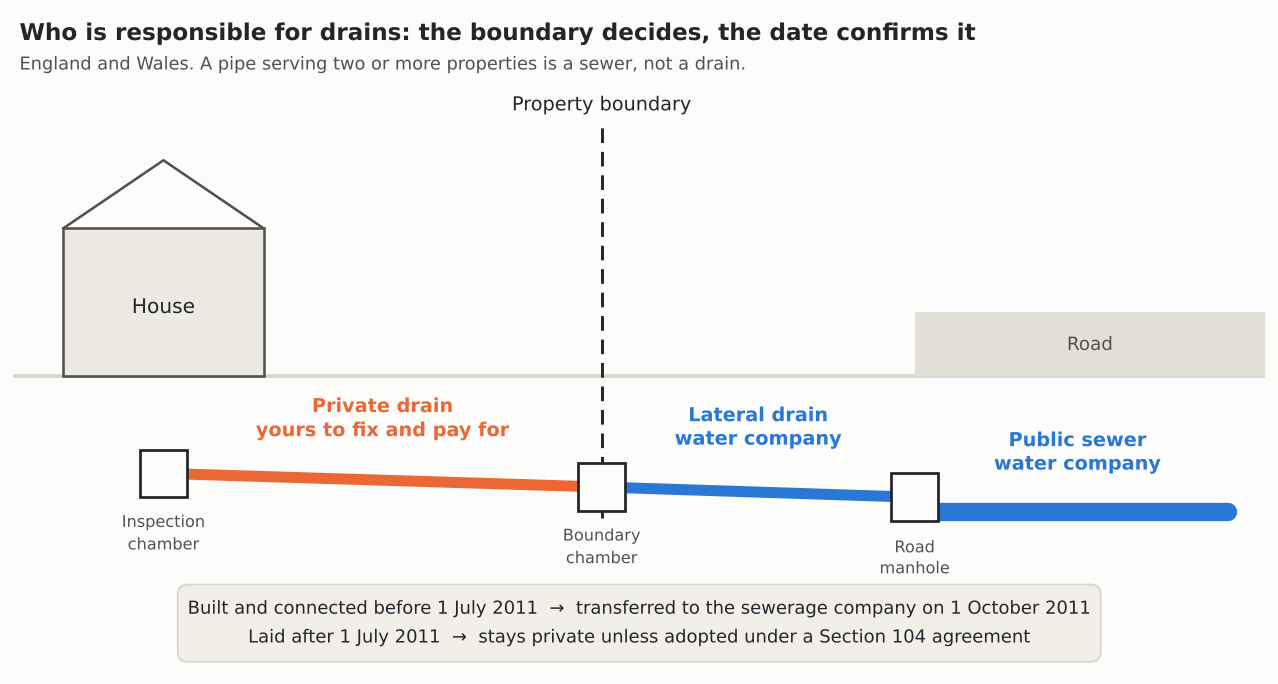
Who is responsible for drains: three words do the work
The Water Industry Act 1991 draws the map in one interpretation section, section 219. It turns on three terms that sound interchangeable and are not.
- Drain — “a drain used for the drainage of one building or of any buildings or yards appurtenant to buildings within the same curtilage”. One building, in short.
- Sewer — everything else that carries drainage. In practice, a pipe serving two or more properties.
- Lateral drain — “that part of a drain which runs from the curtilage of a building” to the sewer it joins. The length past your boundary.
- Public sewer — one vested in a sewerage undertaker.
A rule falls out of those definitions. Serving only your house, inside your boundary, it is your drain. Cross the boundary, or let a neighbour’s waste join it, and the statute stops calling it yours.
The date that settles most arguments
Ownership of those outside lengths changed wholesale. The change is old enough that many homeowners never heard of it.
Anglian Water’s ownership guidance sets out the mechanics. The regulations took effect on 1 October 2011. Sewers and lateral drains built and connected before 1 July 2011 passed to the sewerage company. Anything laid after that July date belongs to the company only once adopted under a Section 104 agreement.
For older pipework the guidance is blunt about what that leaves you with. The owner has no legal or financial duty for problems arising “once they leave the property boundary”.
Two exceptions matter. Pipes that never reach a public sewer sit outside the scheme, so a run to a septic tank or cesspit stays yours whatever its age. A newer estate may also be private all the way to the main. That is why “when was this laid?” belongs in every conversation about a shared pipe.
Walking the chambers, in the order an engineer walks them
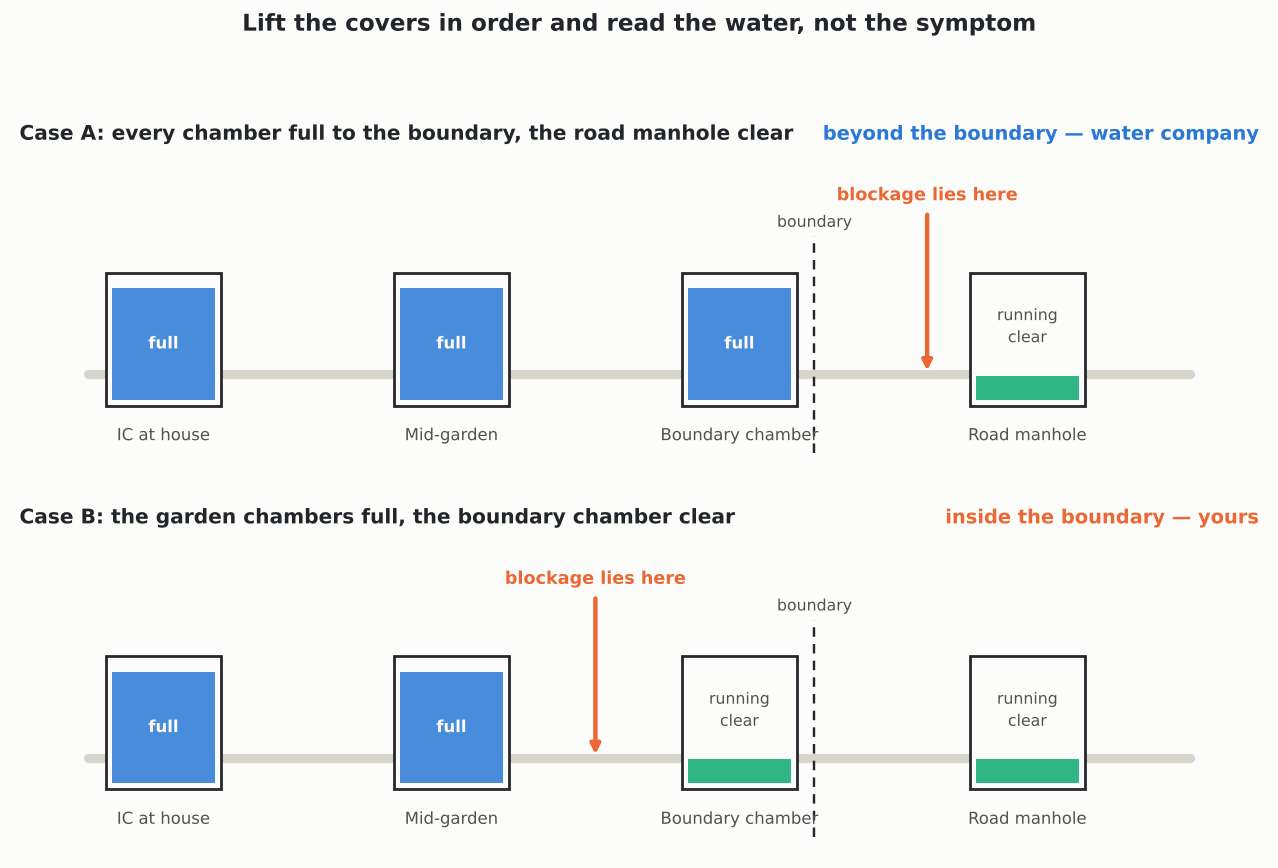
Now the map becomes a site procedure. Water backs up behind an obstruction and runs clear in front of it. So the chambers tell you which length failed, long before anyone orders a camera.
- Get the sewer map first. Your water company must make maps available on request, a duty Citizens Advice lists alongside its obligation to maintain public sewers. The map shows which pipes are theirs.
- Lift covers from the house outwards, in order, never the other way round.
- Read the water level in each. A thin stream means clear. Standing full means surcharged.
- Find the join. The blockage lies between the last surcharged chamber and the first clear one. Only that length is in dispute.
- Check the boundary chamber last. Full, with the road manhole beyond it clear? The obstruction sits past your boundary. Garden chambers full while the boundary chamber runs clear? The fault is inside your land.
One caution on step 5. A chamber standing full with no flow at all has usually been surcharged a while, which points downstream rather than at a fresh blockage there. Photograph every open chamber before you call anyone, because levels change the moment a pipe is rodded.
A persistent smell with no standing water is a different investigation, where a trap or a vent is the likelier culprit. Where the chambers point inside your boundary, rodding from the right chamber in the right direction comes next. A sink that empties slowly while the chambers stay clear is a waste problem, not a drain problem.
Who is responsible for drains when the fall was wrong from the start
A length that blocks every few months is rarely a behaviour problem. More often it was laid too flat. That is measurable rather than arguable.
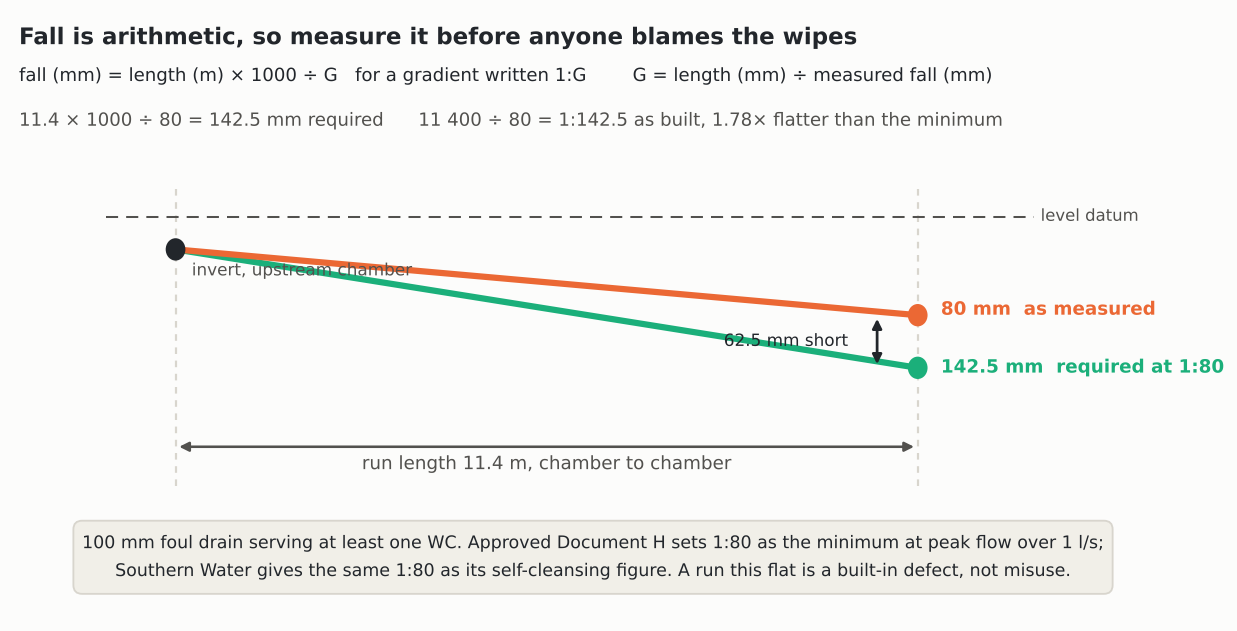
The arithmetic is school-level, which is why it is worth doing yourself:
fall (mm) = length (m) × 1000 ÷ G, for a gradient written 1:G G = length (mm) ÷ measured fall (mm)
Take a real shape. A 100 mm foul drain runs 11.4 m from the inspection chamber to the boundary chamber. Approved Document H, as set out by Local Authority Building Control, puts the minimum at 1:80 for a 100 mm pipe serving at least one WC. Required fall: 11.4 × 1000 ÷ 80 = 142.5 mm.
Now measure. Level across both chamber rims, then drop a tape to each invert. Say the drop comes out at 80 mm. Then G = 11 400 ÷ 80 = 1:142.5. That is about 1.78 times flatter than the minimum, and 62.5 mm short of the fall the pipe needed. A defect, not misuse — and that changes the conversation with a builder, a seller or an insurer.
Two sources agree on the thresholds, which is worth more than either alone. LABC’s reading of Approved Document H and Southern Water’s build-over guidance both give 1:80 as the self-cleansing minimum for 100 mm, and 1:150 for 150 mm.
They differ in one respect worth keeping. The LABC table makes 1:80 conditional on peak flow above 1 l/s with at least one WC, and sets 1:40 for a 100 mm pipe below that flow. Southern Water quotes 1:80 flat. Low-flow runs need the steeper figure, because without a WC flush nothing scours the pipe.
| Pipe | Minimum gradient | Capacity | Condition |
|---|---|---|---|
| 75 mm | 1:40 | 4.1 l/s | peak flow under 1 l/s |
| 100 mm | 1:40 | 9.2 l/s | peak flow under 1 l/s |
| 100 mm | 1:80 | 6.3 l/s | at least 1 WC |
| 150 mm | 1:150 | 15.0 l/s | at least 5 WCs |
Diameters come from the same table: at least 75 mm for any below-ground foul drain, 100 mm once a WC is served, 150 mm beyond ten dwellings.
Scotland, Northern Ireland and the standard underneath
The 2011 transfer was an England and Wales reform. Scotland reaches a similar place by another route. Scottish Water’s guidance says that where the drain leaves your curtilage, or joins drains from another curtilage, “it becomes a public sewer”. Shared pipework within one curtilage, such as a block of flats, stays private. Northern Ireland has its own undertaker, and the detail there sits outside these sources.
A European layer runs underneath all of it. EN 752:2017, “Drain and sewer systems outside buildings — Sewer system management”, was published by CEN in April 2017. It runs the system boundary from where wastewater leaves a building, roof or paved area to its discharge. Construction and testing belong to EN 1610:2015, covering buried gravity pipes up to 0.5 kPa surcharge, including tightness testing after backfilling. Neither standard decides ownership.
Shared pipes, and who actually pays
Shared drainage produces the worst advice, because the intuition runs backwards. Where a lateral drain is shared with a neighbour, Citizens Advice is explicit: you do not maintain it. The water company does. That holds even where the shared lateral runs beneath your own garden.
A genuinely private sewer is the opposite case. Where a pipe serving several properties was never adopted, the owners share the cost between them. That is the position on many unadopted estates. If a company refuses to adopt, the owners can appeal to Ofwat.
When a neighbour will not act, the local authority is the lever rather than the courts. Section 59 of the Building Act 1984 lets a council serve notice where a drain is insufficient, where a private sewer or drain is “so defective as to admit subsoil water”, or where its condition is “prejudicial to health or a nuisance”. Environmental health can require the work, then do it and charge for it if the deadline passes.
A chronically leaking drain is also a damp mechanism, and telling that kind of wet wall from condensation needs its own measurements.
Before anyone digs, the notice nobody gives
Section 61 of the same Act requires at least 24 hours’ notice to the local authority before repairing, reconstructing or altering the course of an underground drain connected to a sewer or cesspool. Emergency work skips the wait, but must not be covered up without the same notice. Failing to give it is a summary offence, carrying a fine up to level 3 on the standard scale.
Building near the pipe has its own thresholds. Southern Water requires consent for any structure built over or within 3 metres of a public sewer.
| Limit | Figure |
|---|---|
| Consent needed within | 3 m of a public sewer |
| Self-declaration route | sewer 225 mm or less, under 3 m deep |
| Built-over length | under 6 m; protection agreement typically at 8 m |
| From manhole or rodding eye | 500 mm horizontally |
| From new foundations | 500 mm horizontally |
| Slab underside to pipe crown | 300 mm |
| Foundations within 3 m | at least 150 mm below the invert |
| Piling | none within 1.0 m auger, 3.0 m driven |
Sewers over 225 mm, or deeper than 3 m, count as critical. Those are not normally approved for building over at all, and diverting one is a Section 185 application.
What does not work
Chemical drain cleaner, on anything underground. It is sold for sink traps and treats the wrong half of the system. A surcharged chamber means a blockage tens of metres away. The product never arrives at working strength.
Booking a CCTV survey first. A camera shows what is in the pipe, not who owns it. Lifting covers is free and decides liability. If a survey is needed anyway, Southern Water accepts a CCTV report dated within six months for a build-over application, so one survey can serve twice.
Clearing a shared blockage out of neighbourliness. On a shared lateral drain you may be buying work the company is obliged to do. Nobody refunds it later.
Jetting old pipe at whatever pressure the van carries. Materials approved for building over are expected to withstand 2600 psi, roughly 180 bar. Older unapproved material may not take it.
Where the answer is genuinely unclear
Three gaps are worth stating rather than papering over.
Northern Ireland is the first. None of the sources here sets out its boundary rule, so confirm the position with the local undertaker rather than assuming the England and Wales model.
The second is testing detail in EN 1610. Its published scope confirms tightness testing after backfilling, but the specific air and water procedures were not visible in the material available. No pressures or durations are quoted above for that reason.
Cost is the third, deliberately. Excavation and lining depend on depth, access and ground, and the figures move constantly. Ask two or three local drainage contractors for the current order of magnitude in your area before budgeting.
One last distinction, because it misdirects people more than any other. Surface water and foul water are separate questions, and who is responsible for drains carrying rainwater follows different pipes entirely. A soakaway that has stopped taking water is a ground problem rather than an ownership one. Rain standing around the house usually starts with gutters that have stopped carrying it away, or a downpipe leaking at its joints. Whether a patio needs a soakaway at all is a run-off question with its own rules.
Sources
- Water Industry Act 1991, section 219 — statutory definitions of drain, sewer, lateral drain and public sewer: legislation.gov.uk
- Building Act 1984, sections 59 to 61 — local authority notices and the 24-hour notice before drain works: legislation.gov.uk
- Anglian Water, sewer ownership guidance — the 1 July 2011 cut-off and the 1 October 2011 transfer: anglianwater.co.uk
- Local Authority Building Control, underground foul drainage — Approved Document H diameters, gradients and capacities: labc.co.uk
- Southern Water, building over a sewer — distances, clearances, piling limits and self-cleansing gradients: southernwater.co.uk
- Scottish Water, drains and sewers in your home — the curtilage rule in Scotland: scottishwater.co.uk
- Citizens Advice, who is responsible for repairing drains and sewers — shared laterals, adoption and the Ofwat appeal: citizensadvice.org.uk
- EN 752:2017 and EN 1610:2015 — CEN scope, committee and publication dates: standards.ie