
Black mould on bedroom walls is the one damp problem people try to solve with a cloth. Sometimes a cloth is the right answer, and the agencies that publish removal guidance say exactly when. More often it is half the job, because the patch is not the problem. It is the receipt for a problem that ran all night, every night, since the heating went on.
So there are two pieces of work here. One is removing what has grown: an afternoon and a short shopping list. The other is removing the water that grew it, which is arithmetic, and which decides whether you do the afternoon again in February. If you have not yet settled whether this is condensation or something coming through the wall from outside, start with the diagnosis — what follows assumes condensation, and on a leak it buys you weeks at most.
Measure the patch first, because half a square metre decides who does the work
Before anything else, measure the affected area. Two national agencies, in two countries, draw the same line in the same place.
Germany’s Umweltbundesamt puts it plainly. Anything over 0.5 m² should always be remediated by a specialist firm. A layperson may do the work where the area is no bigger than roughly half a square metre and there is no structural defect behind it. Switzerland’s Suva, the national accident insurance body that writes the country’s occupational safety guidance, lands on the same threshold: up to about half a square metre is occupant work, and anything larger, or anything that has got into insulation, is not.
Two agencies, two jurisdictions, one number. That is worth more than either alone.
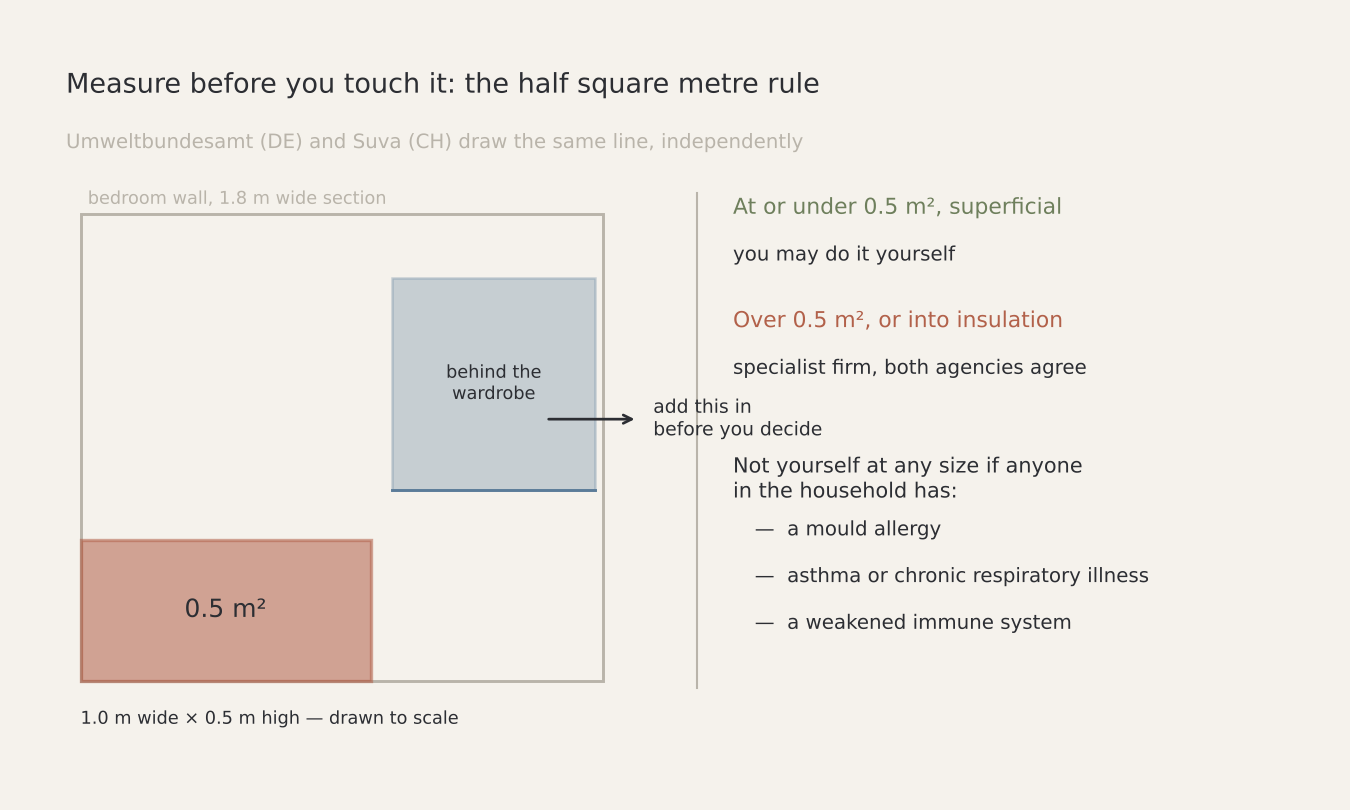
Measure honestly, though. The visible patch is rarely the whole of it, and the area behind a wardrobe on an external wall usually dwarfs the part you can see — mould grows in that gap long before it appears beside it. Pull the furniture out, look behind the headboard, lift the carpet edge at the skirting, and add it all up before you decide.
Three things take the job out of your hands whatever the area. Both the German and the Swiss guidance exclude anyone who is allergic to mould, has asthma or another chronic respiratory condition, or has a weakened immune system. In those households somebody else does the work, or a contractor does.
What to wear, and what actually shifts black mould on bedroom walls
Shut the bedroom door so you are not moving spores through the house, and open the window wide. Then dress for it.
Bremen’s public health office specifies an FFP2 mask, safety goggles and household or disposable gloves. Suva goes one step further and asks for FFP2 as the minimum with FFP3 preferred, plus single-use gloves, goggles, and long sleeves you can wash at 60 °C afterwards. The mask is not theatre. You are about to disturb a colony that has spent three months growing undisturbed.
The method itself is short:
- Wipe damp, never dry. Brushing or scrubbing a dry patch throws spores into the air you are standing in.
- Use alcohol. Bremen says a cloth soaked in spirit at 70–80%. The Umweltbundesamt is more precise about why there are two numbers: 70% ethanol on dry surfaces, 80% on damp ones. Suva accepts a minimum of 70% alcohol or isopropanol.
- Keep the quantity small and the window open. Alcohol vapour at that strength is highly flammable, and all three sources say so.
- Afterwards, wipe every surface in the room with ordinary household cleaner, not just the wall.
- Vacuum carpets and soft furnishings only with a HEPA-filtered machine. An ordinary vacuum passes spores straight through the bag and back into the room.
Here the sources disagree, and the disagreement is worth keeping. UK local authority guidance — Northumberland County Council’s is typical — tells residents to use a fungicidal wash carrying an HSE approval number. The Umweltbundesamt advises against chemical fungicide solutions indoors altogether: the actives can persist in indoor air and put occupants at risk, and sprays do nothing for the surface while the cause runs. Suva notes that commercial anti-mould products are generally chlorine-based and often contain biocides.
Our reading: on a small patch on a hard surface, alcohol does what the German and Swiss agencies describe, and a biocide buys little when you are going to remove the substrate anyway. The case for the fungicidal wash gets stronger the less of the material you can take away. What none of the three claims is that any product stops the mould returning.
What has to come off the wall rather than be cleaned
Porous materials do not get cleaned. They get removed, and this is where most attempts on black mould on bedroom walls quietly fail.
Bremen’s list is specific. Mouldy wallpaper comes off. So does plaster that is wet or soft — and plaster that is merely discoloured, because the discolouration says it was wet earlier. Black silicone joints are renewed, never scrubbed. Open-pored timber such as a cabinet back is replaced. Upholstered furniture with heavy growth goes, as do affected shoes, and carpet goes if you are in any doubt.
Textiles are the exception: keep them if you can wash them at 60 °C or above. Everything that cannot be cleaned goes into a plastic bag, sealed tight, into the general waste — not loose into a bag you then carry open through the hall. Bedding and anything stored against a cold wall needs the same treatment, and mould on clothes, shoes and mattresses follows its own rules.
One more from Bremen, because the trade sells against it every winter: painting over the patch with anti-mould paint does not help. The moisture source has to go, or the mould comes back through whatever you put on top.
Why black mould on bedroom walls comes back: the water two sleepers leave behind
Now the arithmetic that decides everything after the afternoon’s work.
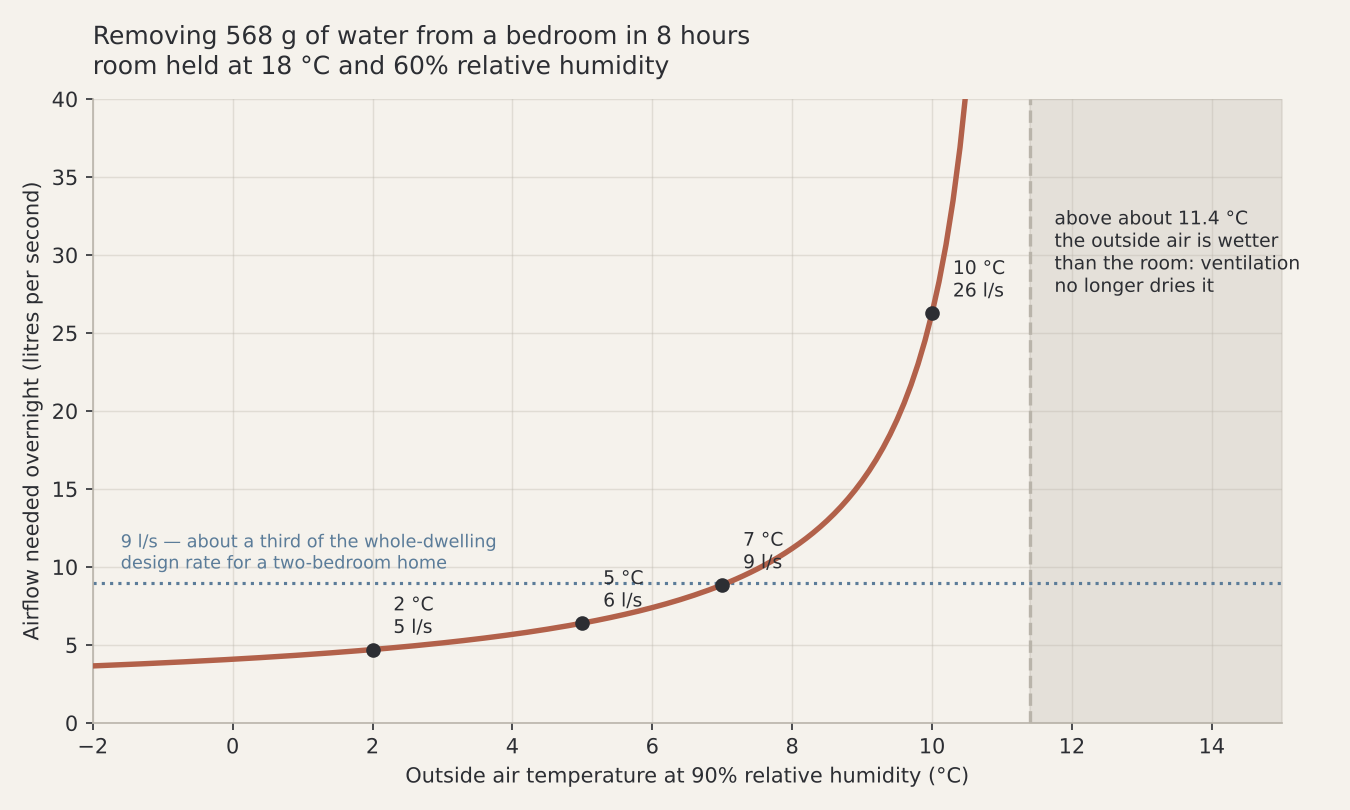
Northumberland County Council’s figures, the set used across UK local authority condensation advice, put one sleeping adult at half a pint of water released into the room overnight. Two adults in a double bed, then, hand the bedroom roughly one pint — 568 ml — between lights out and the alarm. That water has to leave, or the coldest surface in the room collects it.
Ventilation removes it only in proportion to how much drier the outside air is. That has to be measured as absolute humidity, in grams per cubic metre, not as a percentage. The reading on a cheap hygrometer cannot answer the question alone, because 90% at 7 °C and 60% at 18 °C are very different amounts of water.
The formula, so you can check it. Saturation vapour pressure, in hPa, is 6.112 × exp(17.62 t / (243.12 + t)). Multiply by the relative humidity to get the actual vapour pressure, convert to pascals, then divide by 461.5 × (273.15 + t) and multiply by 1000 for grams per cubic metre. A bedroom at 18 °C and 60% holds 9.19 g/m³. Outside at 7 °C and 90% holds 6.97 g/m³. The difference, 2.23 g/m³, is all the drying capacity each cubic metre of incoming air has.
| Outside, overnight, at 90% humidity | Water in outside air | Drying capacity | Airflow needed for 568 g over 8 hours |
|---|---|---|---|
| 2 °C | 5.00 g/m³ | 4.19 g/m³ | 5 l/s |
| 5 °C | 6.11 g/m³ | 3.08 g/m³ | 6 l/s |
| 7 °C | 6.97 g/m³ | 2.23 g/m³ | 9 l/s |
| 10 °C | 8.44 g/m³ | 0.75 g/m³ | 26 l/s |
| 12 °C | 9.57 g/m³ | none | the outside air is wetter |
Read the 7 °C row, then look at what a bedroom actually gets. Nine litres per second through one closed door is 1.26 air changes an hour in a 3.5 m by 3.0 m room with a 2.4 m ceiling. Put that beside Approved Document F, the ventilation guidance in force for England and Wales. It sets the whole-dwelling design rate for a two-bedroom home at 25 l/s. A habitable room in a multi-storey dwelling gets a background ventilator of 8000 mm² equivalent area, and the bathroom gets 15 l/s of intermittent extract.
So one bedroom, door shut, wants about a third of the whole home’s design ventilation rate through a single trickle vent. On a cold night it can just about get there, with the vent open and the door undercut. With the vent painted shut, which is what you usually find, it does not get close. That is why getting the household’s moisture load down does more than any product you can buy.
The nights when opening the window does nothing
Look at the last two rows of that table again, because they overturn the standard advice.
At 12 °C and 90% outside, the outdoor air already holds more water per cubic metre than the room does. Opening the window on that night does not dry the bedroom. It wets it, slowly, while making the walls colder — and colder walls are the actual condensing surface. Running the same calculation across the range, a room at 18 °C and 60% stops gaining anything from outdoor air at 90% once the outside temperature passes about 11.4 °C.
Mild, wet, still nights in October and November sit exactly there. On those nights the lever is heat or a dehumidifier, not the window. On a cold clear night the window is extremely effective and costs you nothing but warmth you then have to put back.
France’s public health service recommends opening up wide for at least 10 minutes twice a day, heated rooms between 18 °C and 22 °C, and relative humidity between 40% and 60%. Suva’s version is several bursts of 5 to 10 minutes with windows fully open, 19 to 21 °C, and the same 40–60% band. Both are sound defaults. Neither replaces checking, on the night, whether the air you let in is drier than the air you let out. Where background ventilation cannot do the work, a fan or a positive input unit is the next question.
Four fixes that do not fix it
- Anti-mould paint over a live patch. Bremen is explicit that it does not help while the moisture source runs.
- Vinegar on plaster or render. The Umweltbundesamt warns that lime-based materials neutralise the acid, and that the residue can feed growth rather than stop it. Suva gives the same warning for mineral surfaces.
- A stiff brush, or the household vacuum. Both send spores airborne. Damp wiping and a HEPA machine, or nothing.
- Putting the wardrobe straight back. Suva asks for at least 10 cm between furniture and an external wall, so that air can reach the surface at all.
When it stops being your job
If you rent from a social landlord in England, the timescales are now statutory rather than a matter of goodwill. Awaab’s Law came into force for the social rented sector on 27 October 2025, under the Hazards in Social Housing (Prescribed Requirements) (England) Regulations 2025. Where a reported damp and mould hazard is potentially significant, the landlord must investigate within 10 working days of becoming aware of it, provide a written summary of the findings within 3 working days of concluding that investigation, and begin relevant safety work within 5 working days. Where the hazard presents an imminent risk, investigation and safety work both fall inside 24 hours. Further preventative work should start within 5 working days, or as soon as reasonably practicable and within 12 weeks.
Those deadlines run from when the landlord becomes aware, so the date you report it is the date that matters. Report in writing, photograph the patch with something in frame for scale, and keep the thread.
Be clear about the limits, though: these timescales bind social landlords in England. If you rent privately, or you are elsewhere in the UK or in another EU country, they do not apply to your tenancy, and the route is a different one this article does not cover.
What travels further is the government’s position on where the fault lies. The UKHSA and DHSC guidance for housing providers calls it “totally unreasonable to blame damp and mould in the home on ‘lifestyle choices'”, and puts the fundamental causes down to building deficiencies, inadequate ventilation, inadequate heating and poor energy efficiency. Cooking, washing and breathing are not lifestyle choices. The same guidance notes that visible mould, a musty odour or water damage is itself sufficient evidence that something needs remedying.
Where your own competence ends with black mould on bedroom walls
Call somebody about black mould on bedroom walls in four cases: the area is over roughly half a square metre; anyone in the household is in one of the risk groups; the growth has got behind insulation or into the structure; or it returns after you have genuinely fixed the moisture source. The health guidance is blunt about the stakes. Damp and mould primarily affect the airways and lungs, can cause serious illness, and in the most severe cases can contribute to death. Children, older people, pregnant women and anyone with a pre-existing respiratory or immune condition are the most exposed.
And give the fix time. The same guidance advises allowing at least six weeks after treatment before revisiting a property to see whether it worked. A wall that was wet for three months does not dry in a weekend, and a clean wall in week two tells you nothing yet.
Sources
- Umweltbundesamt, Germany — Was tun bei Schimmel in meiner Wohnung?: the 0.5 m² threshold for specialist remediation; 70% ethanol on dry surfaces and 80% on damp; advice against chemical fungicide solutions indoors; vinegar not recommended on lime-based materials; HEPA vacuuming.
- Gesundheitsamt Bremen, Germany — Schimmel entfernen: So wird’s gemacht: FFP2 mask, goggles and gloves; 70–80% alcohol; wallpaper, soft or discoloured plaster and silicone joints removed rather than cleaned; textiles washed at 60 °C or above; anti-mould paint does not help.
- Suva, Switzerland — Éliminer les moisissures: about half a square metre as the occupant limit; FFP2 minimum and FFP3 preferred; minimum 70% alcohol or isopropanol; commercial products generally chlorine-based; 5 to 10 minute airing bursts, 19 to 21 °C, 40 to 60% humidity, 10 cm clearance behind furniture.
- Santé.fr, France — Comment limiter l’humidité dans son logement ?: airing at least 10 minutes twice a day; heated rooms between 18 °C and 22 °C; relative humidity between 40% and 60%.
- Northumberland County Council, United Kingdom — Condensation Advice: half a pint of water per sleeping person overnight, and the rest of the household moisture figures; fungicidal wash with an HSE approval number; no brushing or vacuuming of mould.
- Ministry of Housing, Communities and Local Government, United Kingdom — Approved Document F, Volume 1: Dwellings: whole-dwelling rate of 25 l/s for two bedrooms, 8000 mm² background ventilator equivalent area for habitable rooms, 15 l/s intermittent extract in a bathroom. The 2026 edition applies to work from 24 March 2027.
- Ministry of Housing, Communities and Local Government, United Kingdom — Awaab’s Law: guidance for social landlords: in force from 27 October 2025; 10 working days to investigate, 3 working days for the written summary, 5 working days to begin safety work, 24 hours for emergencies, 12 weeks for further preventative work.
- Department of Health and Social Care and UK Health Security Agency — Understanding and addressing the health risks of damp and mould in the home: respiratory effects and vulnerable groups; “totally unreasonable to blame damp and mould in the home on ‘lifestyle choices'”; observable dampness is sufficient to indicate the need to remedy; at least six weeks before revisiting after treatment.