
Asking whether you have damp or condensation sounds like a quarrel about words. It is not. The answer decides who you call, what you buy, and whether the black patch returns in a fortnight. Condensation is water your own household made, landing on a surface too cold to hold it. Penetrating damp is rainwater crossing the fabric from outside. Rising damp is groundwater moving up through masonry. Three problems, three trades, three repairs that share almost nothing.
All three grow the same mould in the same corner. That is why the corner itself tells you so little, and why a thermometer tells you so much.
Damp or condensation: the two numbers that settle it
Borrow two instruments: a thermohygrometer for room air, and an infrared thermometer for surfaces. Take four readings on a cold evening, with the heating running the way you normally run it.
- Air temperature and relative humidity in the middle of the room.
- Surface temperature on the worst part of the stain.
- Surface temperature of an internal wall in the same room, as a control.
- Outdoor temperature.
Those four numbers answer damp or condensation on their own, and everything after them is confirmation. Write them down with the date. One set of readings is an anecdote. Three cold evenings make a record, and a record is what stops the next person on site from guessing.
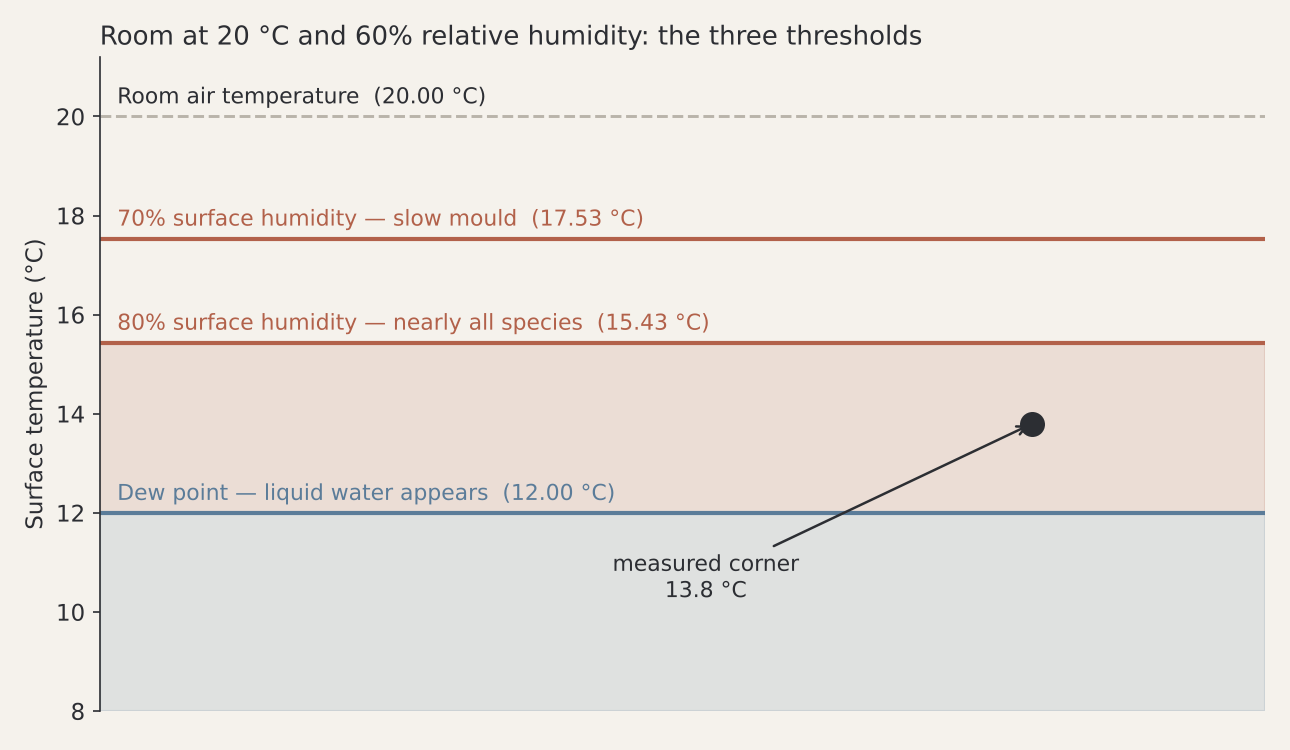
Now the arithmetic. Air at 20 °C and 60% relative humidity carries a vapour pressure of 14.00 hPa and saturates at 12.00 °C, so any surface below 12 °C grows visible water. That is the dew point, and most advice stops there.
Stopping there is the mistake. German federal guidance from the Umweltbundesamt is explicit that mould never waits for liquid water: a relative humidity of 70% to 80% at the material surface is enough when it persists, and above 80% "nearly all mould species and bacteria can grow". The guide puts the floor at roughly 70%, the matching water activity at 0.80 to 0.85, and the time to visible growth at a few days to a few weeks.
Push the same air through that criterion and the threshold climbs a long way up the wall. In a room at 20 °C and 60%, the surface reaches 80% humidity at 15.43 °C and 70% at 17.53 °C. Your wall never dripped. It never needed to.
| Room air | Dew point | Surface at 80% RH | Surface at 70% RH |
|---|---|---|---|
| 20 °C, 50% | 9.26 °C | 12.62 °C | 14.67 °C |
| 20 °C, 60% | 12.00 °C | 15.43 °C | 17.53 °C |
| 20 °C, 70% | 14.36 °C | 17.86 °C | 20.00 °C |
| 18 °C, 65% | 11.32 °C | 14.74 °C | 16.83 °C |
Read the last row of the third column. At 20 °C and 70% humidity, the 70% surface threshold lands on 20.00 °C, the air temperature itself. A room held that wet has no safe surface anywhere, which is why getting the indoor humidity down comes before any decorating.
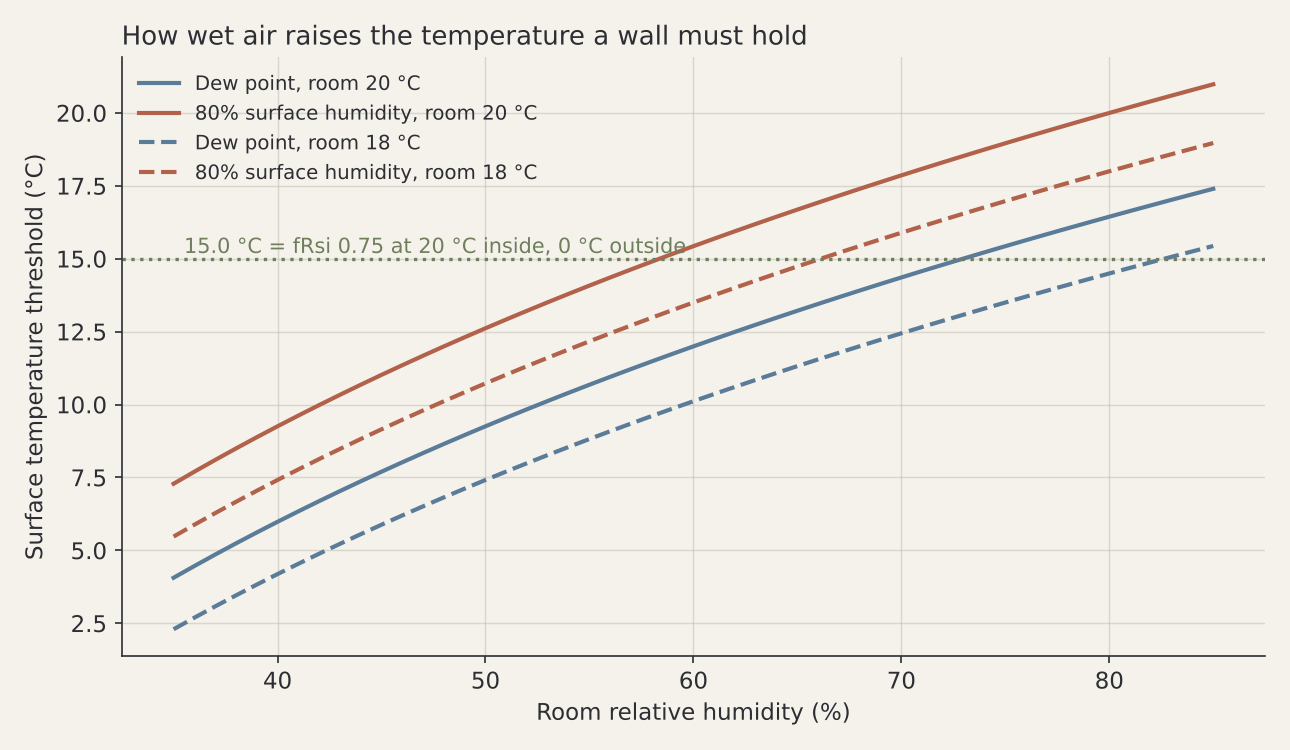
The formula, so you can check it. Saturation vapour pressure in hPa is 6.112 × exp(17.62 t / (243.12 + t)), using the Magnus coefficients published in Sensirion's humidity conversion formulas. At 20 °C that gives 23.326 hPa; at 60% relative humidity, 13.996 hPa of actual vapour. Divide by 0.80 for the mould threshold, giving 17.495 hPa, then invert the same equation: 15.43 °C. Every figure in the table above came out of that calculation.
Telling damp or condensation apart by where the patch sits
Measurement tells you whether a surface is cold enough. Geometry settles damp or condensation when the readings come out borderline.
Condensation picks cold geometry: external corners, the wall-to-ceiling junction, window reveals, the strip behind a wardrobe on an outside wall, an unheated spare bedroom. It arrives with the heating season and fades in summer. It is worst where air cannot move, which is why mould grows behind furniture before it appears on the open wall beside it.
Penetrating damp ignores geometry and follows water. The patch sits under a cracked gutter joint, beside a chimney, below a sill, on the elevation that takes the prevailing rain, and it darkens a day or two after heavy weather. Rising damp is the slow one: a horizontal tide mark about a metre up, salt bloom, plaster crumbling at skirting level, no seasonal rhythm at all. Those two belong to a separate investigation, and telling rising damp from rain damp needs its own tests.
Spread matters as much as position. The UK government's best-practice guide for internal wall insulation sorts mould by extent: widespread mould or condensation points to poor ventilation or underheating, while localised mould points to thermal bridging or water ingress. Two sharp patches in two corners is a geometry problem. A grey film across an entire external wall is an air problem — or a heating one, which is a different diagnosis again and starts with what the pressure gauge says about the system.
Windows are the cheapest witness in the house. They are usually the coldest surface in the room, so they report the dew point before the walls do, and water on the glass every morning tells you the night air was wet, nothing more.
What a moisture meter actually tells you
No meter reading decides damp or condensation by itself, and this is where self-diagnosis goes wrong, with plenty of paid diagnosis alongside it.
A hand-held electrical meter does not measure the moisture content of plaster. It measures conductivity and reports it as a Wood Moisture Equivalent, as though the material were timber. Protimeter's own technical review states that these instruments measure only the free water in a material, that salts can cause them to over-read, and that carbonaceous materials such as some breeze blocks and black wallpaper conduct as well. Anything above 20% WME sits in their red zone, which corresponds to a humidity equilibrium above about 85%.
The same document demolishes the idea that one percentage fits every material. Most plasters are wet at 1%. Lime mortar is dry at 5%, while cement mortar at 5% is wet. Wood does not feel damp below 30%, yet rot begins at 20%, and a safe 75% relative humidity inside a material equals only 16% to 18% moisture content in timber.
That 20% figure for timber is one of the few numbers two independent sources give identically: the government insulation guide sets the same limit and says work should not proceed over embedded joists above it. So when a surveyor waves a meter at your plaster and reads out a percentage, the honest translation is "this surface conducts more than its neighbours". Useful for comparison. Not proof of rising damp — official guidance says rising damp "is often misdiagnosed" and that chemical testing is the appropriate way to confirm it. There is more to say about what a damp meter reading is worth than fits here.
Is the cold corner your fault or the building's?
There is a published number for this, and it is the most useful sum a householder can do.
Building physics uses the temperature factor fRsi = (Tsi − Te) / (Ti − Te), with Tsi the internal surface temperature, Ti the room air temperature and Te the outdoor temperature. Research commissioned for the Building Regulations describes it as a risk indicator for mould growth, models junctions at 20 °C inside and 0 °C outside, and sets the target at 0.75 — a minimum surface temperature of 15 °C. The same study reports a real junction whose lowest surface temperature came out at 8.3 °C, an fRsi of 0.42, which it calls a risk of mould growth outright. The insulation guide sets the identical bar: every thermal bridge mitigated above 0.75.
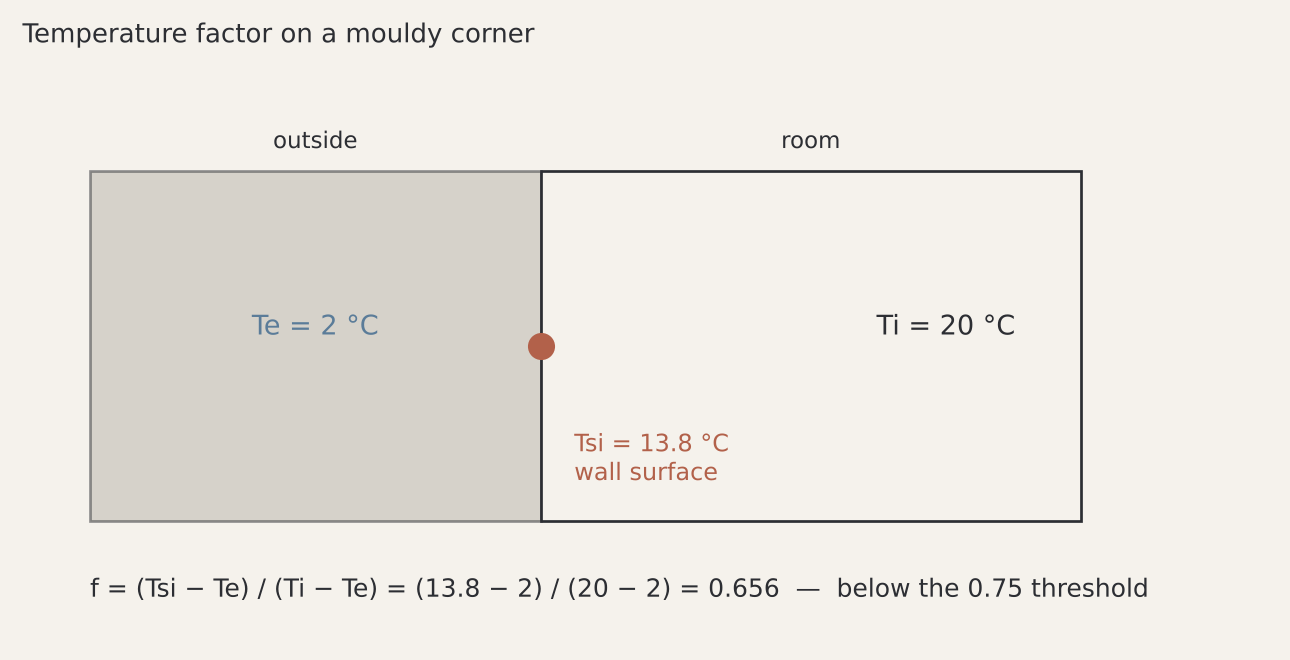
You already have the three temperatures. Say the mouldy corner reads 13.8 °C while the room sits at 20 °C and it is 2 °C outside. Then f = (13.8 − 2) / (20 − 2) = 0.656. That is below 0.75 on a mild day, which makes the corner a fabric defect rather than a housekeeping failure. Run the same sum on your control wall; a gap of two or three tenths between two walls in one room is a thermal bridge. The sum turns damp or condensation from an argument with a landlord into a number.
Notice where the two halves of this article meet. The regulatory threshold of 0.75 puts the surface at 15.00 °C when it is freezing outside. The biological threshold at 20 °C and 60% humidity puts it at 15.43 °C. A building standard and a fungus arrive at nearly the same temperature from opposite directions.
Count the ventilation you actually have
If the air is too wet, ask where the moisture is supposed to leave.
England's Approved Document F, in force since 15 June 2022, sets minimum intermittent extract rates of 30 l/s for a kitchen with a cooker hood ducted outside, 60 l/s without one, 30 l/s for a utility room, 15 l/s for a bathroom and 6 l/s for a WC. Continuous systems run lower: 13, 8, 8 and 6 l/s respectively. Whole-dwelling rates run 19, 25, 31, 37 and 43 l/s for one to five bedrooms, plus 6 l/s per extra bedroom, with a floor of 0.3 l/s per square metre. A 90 m² house therefore needs 27 l/s on the area rule and 31 l/s on the bedroom rule, and you take the higher. The 2026 edition, effective 24 March 2027, carries every one of those figures forward unchanged.
France writes the same requirement as a total flow. Under the arrêté of 24 March 1982, summarised in the indoor air quality guide of the DREAL for Hauts-de-France, kitchen extract runs from 75 m³/h in a one-room dwelling to 135 m³/h at five rooms or more. Converted at 3.6, that band is 20.8 to 37.5 l/s — the same territory as the English 13 to 30 l/s. The French guide also recommends keeping rooms between 30% and 70% relative humidity, and insists on sweep ventilation: air must be able to cross from dry rooms to wet ones, so blocked door gaps defeat any extract fan, mechanical ventilation systems included.
Measuring a fan properly needs a calibrated hood. A rough check you can do tonight: tape a bin liner of known volume over the grille and time the fill. Forty litres in three seconds is about 13 l/s. The number reads low, because the bag throttles the fan, but a bag that takes half a minute is telling you something no calibration would soften.
What does not work
Each of the following is bought by somebody who answered damp or condensation wrongly.
- A dehumidifier against penetrating or rising damp. It dries air while liquid water feeds the wall. On true condensation it earns its keep; on the other two it hides the symptom. Worth reading first: do dehumidifiers dry out damp walls.
- Anti-mould paint over a cold bridge. It kills what is there. The corner still sits at 13.8 °C, surface humidity still reaches 80%, and growth returns on the biological timetable of days to weeks.
- Tanking a wall against rising damp. The government's insulation guide advises against it explicitly. Sealing water into masonry moves the problem rather than ending it.
- Blocking air bricks and taping vents to stop draughts. Indoor humidity rises in every room, and two cold corners become one whole wall.
- Blaming the occupants. Current government guidance is blunt: "It is totally unreasonable to blame damp and mould in the home on 'lifestyle choices'", and names building deficiencies, inadequate ventilation, inadequate heating or poor energy efficiency as the fundamental causes.
Where your competence ends, and what to hand over
Hand the damp or condensation question over with your readings attached, not as an opinion. Everything above is yours: readings, a humidity log, a bag over a fan, a temperature factor, a note of what the patch does after rain. None of it opens the building up.
Three things are not yours. Confirming rising damp needs drilled samples and a laboratory method. Thermal bridge modelling at a junction uses BRE Information Paper 1/06 and software. Roofs, structure and electrics belong to someone insured for them. Official guidance adds a warning worth repeating to any landlord: do not assume you can diagnose it yourself in every case, an inspection beats a verdict from photographs, and allow at least six weeks after treatment before judging whether it worked.
The health case for not waiting is settled rather than alarmist. The WHO guidelines for indoor air quality state that persistent dampness and microbial growth on interior surfaces should be avoided or minimised. They estimate that indoor dampness affects 10% to 50% of indoor environments across Europe, North America, Australia, India and Japan. On a safe level, they are unambiguous: no quantitative health-based threshold for microbial contamination can be recommended. Occupants of damp buildings run a raised risk of respiratory symptoms, respiratory infections and asthma exacerbation, and remediation reduces those outcomes. Clearing the growth itself follows its own rules, set out in how to remove black mould and stop it returning.
On cost, ask two or three local contractors for an order of magnitude before committing to anything; rates for survey work, ventilation and replastering vary too much by region and season for a figure written here to be honest. Arrive at that conversation with your readings, your dates, your fRsi sum and the pattern after rain. That is a specification. Without it, you are buying whichever remedy the visitor happens to sell.
Surse
- Umweltbundesamt, Germany — Leitfaden zur Vorbeugung, Erfassung und Sanierung von Schimmelbefall in Gebäuden: 70% to 80% surface humidity is enough for mould; above 80%, nearly all species grow; water activity 0.80 to 0.85; days to weeks to visible growth.
- GOV.UK, United Kingdom — Understanding and addressing the health risks of damp and mould in the home: definitions of condensation, penetrating and rising damp; rising damp often misdiagnosed, chemical testing the appropriate confirmation; lifestyle blame "totally unreasonable"; six weeks before revisiting.
- DESNZ, United Kingdom — Retrofit Internal Wall Insulation: Guide to Best Practice: thermal bridges mitigated above fRsi 0.75; widespread versus localised mould; timber moisture content not above 20%; advice against tanking for rising damp.
- MHCLG, United Kingdom — Research into resistance to moisture in buildings: fRsi formula and its use as a mould risk indicator; 0.75 and 15 °C at 20 °C inside, 0 °C outside; worked example at 8.3 °C giving 0.42.
- HM Government, United Kingdom — Approved Document F, Volume 1: Dwellings, 2021 edition and the 2026 edition: extract and whole-dwelling ventilation rates, unchanged between editions.
- DREAL Hauts-de-France, France — Guide qualité de l'air intérieur: kitchen extract of 75 to 135 m³/h under the arrêté of 24 March 1982; 30% to 70% indoor humidity; sweep ventilation.
- Protimeter / Amphenol — Moisture measurement technical review: Wood Moisture Equivalent; salts cause over-reading; 20% WME red zone; plaster, lime and cement thresholds; rot at 20% in timber.
- Sensirion, Switzerland — Humidity at a Glance: Magnus coefficients 17.62 and 243.12 °C, and 6.112 hPa, used for every dew point figure above.
- World Health Organization — Guidelines for Indoor Air Quality: Dampness and Mould: persistent dampness to be avoided or minimised; 10% to 50% of indoor environments affected; no safe threshold; respiratory outcomes.